 Ability Scores: +2 Strength, +1 Constitution
Size: Medium (7 to 8 feet tall)
Speed: 30 ft.
Languages: Common, Hyrontus
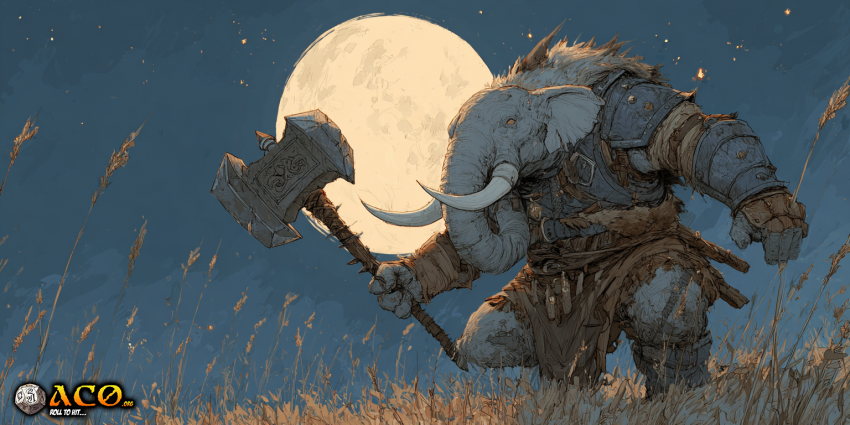
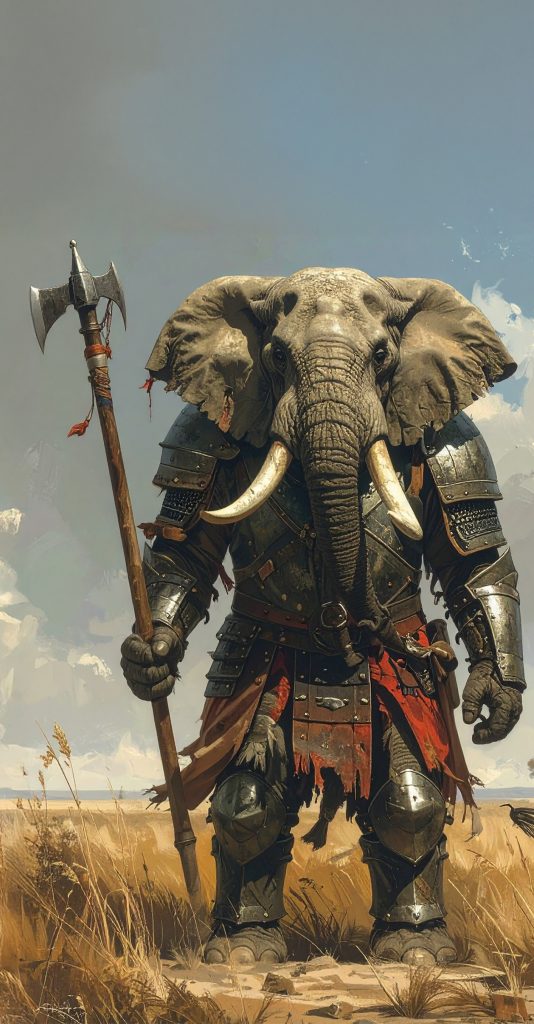
The Hyrontus are towering, ivory-skinned humanoids with elephantine features: a short, dexterous trunk, broad, muscular frames, and leaf-shaped ears that swivel to catch the faintest sound across the grasslands. Once nomads of the savannah, their reputation as unyielding warriors and wise companions is legend. Despite their fearsome might, the Hyrontus are guided by deep honor, loyalty, and a desire for harmony.
For centuries, the Hyrontus avoided the conflicts of the world, wandering the open grasslands and surviving by their wits and strength. This changed with the rise of the dark sorcerer Xarath, whose monstrous horde threatened all. The Hyrontus stood among the few to resist, and their valor at the battle of Grentoruk Khoroth—where the mighty Raxus ScarTrunk led the charge—turned the tide of the war. Since then, the Hyrontus have become steadfast allies to many, but remain protectors of their homeland and wary of the Varkari raiders who prowl their borders.
Traits:
- Age: Hyrontus mature slowly, reaching adulthood by 25 and living up to 180 years.
- Alignment: Most Hyrontus are neutral good, upholding honor, loyalty, and peace.
- Powerful Build: You count as one size larger when determining your carrying capacity and the weight you can push, drag, or lift.
- Elephantine Resilience: You have advantage on saving throws against being frightened, and you have resistance to cold and fire damage.
- Natural Armor: Your thick hide gives you an Armor Class of 13 + your Constitution modifier when not wearing armor. You can use a shield and still gain this benefit.
- Trunk: You can use your trunk to lift, carry, push, or pull objects, or to make simple tasks such as opening doors, drinking, or retrieving small items. Your trunk can’t wield weapons or shields, but can be used to deliver an unarmed strike (1d6 bludgeoning damage; use your Strength modifier).
- Warrior’s Charge: If you move at least 20 feet straight toward a target and then hit it with a melee weapon attack on the same turn, you can immediately deal an extra 1d8 damage of the weapon’s type. Once you use this trait, you can’t use it again until you finish a short or long rest.
- Savannah-Born: You have proficiency in Survival and one of the following: Athletics or Perception.
- Infravision: You can see in darkness as if it were dim light within 60 feet, and you can discern heat signatures, though not colors.
- Martial Training: You are proficient with flails, spears, and the Hyrontus war flail (see below).
- Languages: You can speak, read, and write Common and Hyrontus.
Culture & Appearance:
Hyrontus communities are tight-knit and honor-driven, led by decorated military leaders and wise elders. Their society is structured around martial ranks, and nearly all Hyrontus receive some military training. They favor intricate armor made from hammered brass and copper, and wield fearsome flails with bladed, ball-shaped heads—both a symbol of heritage and a weapon of war. Their deep voices carry the accents of West Africa, resonant and commanding.
Physical: 7–8 feet tall, ivory-white skin, short trunk, broad shoulders, muscular, leaf-like ears, sharp eyes.
Hyrontus War Flail:
A unique martial weapon, favored by the Hyrontus.
Hyrontus War Flail (martial melee weapon): 1d10 bludgeoning or slashing damage (choose on hit), versatile (1d12), 5 lbs.
Playing a Hyrontus:
As a Hyrontus, you are a symbol of honor, strength, and tradition. You may be a military officer, wandering sellsword, spiritual cleric (Gor’zol), or ranger (Ul’Thoros) patrolling the wild. Your people’s legacy calls you to greatness—whether on the battlefield or as a wise leader.
Sample Hyrontus Names:
Male: Raxus, Korran, Juba, Mamadou, Sira, Dakarai
Female: Amara, Enara, Tano, Nana, Sira, Zola
Sample Hyrontus Traits:
- Towering, muscular frame
- Short, flexible trunk
- Intricate, gleaming armor
- Deep, resonant voice with West African accent
- Fierce yet compassionate
“In every dawn, we remember the charge at Grentoruk Khoroth. Strength is our shield, honor our guide.” —Raxus ScarTrunk, Karnat of the Hyrontus
There is only one Hyrontus magic-user and he is called the Thaldrax Gorlakahn. He is the descendent of Raxus ScarTrunk. His family lineage was infused with power at the last battle of the Xarath War. When it is time to select a new Thaldrax Gorlakahn, it will always be from this lineage. They will always be the defacto “King” of the Hyrontus.
The Hyrontus military ranks are as follows:
| WORD | RANK |
| Karanjor | Trainee |
| Volor | Private |
| Drogath | Corporal |
| Vorn’than | Sergeant |
| Thund’kor | Lieutenant |
| Ul’Fog | Captain |
| Ul’Thoros | Ranger |
| Karnat | Major |
| Vor’Gath | Colonel |
| Khor’mar | General |
| Gor’zol | Cleric |
| Thaldrax Gorlakahn | Wizard Leader |
These ranks reflect the Hyrontus’ fierce warrior nature and their emphasis on loyalty and honor. They are designed to inspire respect and obedience while also acknowledging the bravery and skill of individual soldiers.
The Hyrontus have a long-standing rivalry with the Varkari, a race of fierce, hyena/boar-like creatures that are known for their savagery and brutality. The Varkari are known to raid Hyrontus settlements, attacking with overwhelming force and taking whatever they can carry away.
The two races have been at odds for centuries, with each side blaming the other for the violence and aggression that has taken place. Hyrontus view the Varkari as a barbaric and unpredictable race, prone to violence and destruction. Conversely, the Varkari view the Hyrontus as a threat to their way of life, encroaching on their territory and resources.
The tension between the two races has only grown in recent years, with skirmishes and raids becoming more frequent. Some Hyrontus believe that the only way to bring about lasting peace is to wipe out the Varkari entirely, while others believe that diplomacy and negotiation are the better path forward. Regardless of their individual beliefs, the Hyrontus know that the Varkari are a formidable foe, and that any conflict with them will be deadly and dangerous.
© 2025 Kip Shelton, AC0